‘Not an oratorio, but a bawdy opera’ was a contemporary critic's disgusted comment after the first performances of Handel's Semele in 1744.
Semele was Pinchgut Opera’s very first production 24 years ago. It was already a harbinger of glories to come, but when they began, Pinchgut's credo was very different. They wanted to perform operas in what one might call semi-staged events, claiming that the music was what mattered to them, much more than the drama. Semele was thus a perfect choice, being neither oratorio (far too bawdy) or an opera (not in Italian).
Seeing how far the company has come since their inception in terms of staging, it occurred to me that the care they now take to integrate the staging into the music has actually enhanced the music itself, given it a third dimension, as it were, to add to the dimensions of melody and harmony.
The story is about Semele’s desires, both for sexual union with the king of the gods, and also for immortality. Like Narcissus, she falls in love with her own image; like Arjuna, she asks to see the divine form of the god. When Arjuna asks Krishna to show himself in his divine form, he does so in supreme humility. He survives. When Semele asks Jupiter the same question, she does so in a state of hubristic egoism. She is burnt to death.
Everything Neil Armfield touches turns to gold. In part because of Semele's nature as part-opera, part-oratorio, it is a great challenge to produce on stage. Armfield surmounts this challenge in many ways. Firstly and most importantly, he got every cast member to inhabit their character. From casting (the enormous bass voice of Andrew O’Connor as Somnus, for example, or the clown skills of Myriam Arbouz as Iris) to the way the cast moved on stage, each character was uniquely themselves, something still rare in opera.
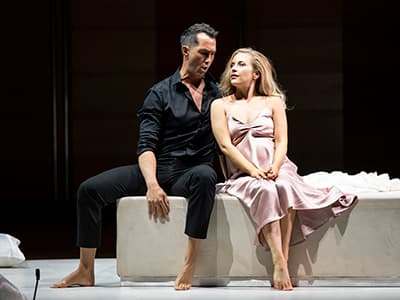
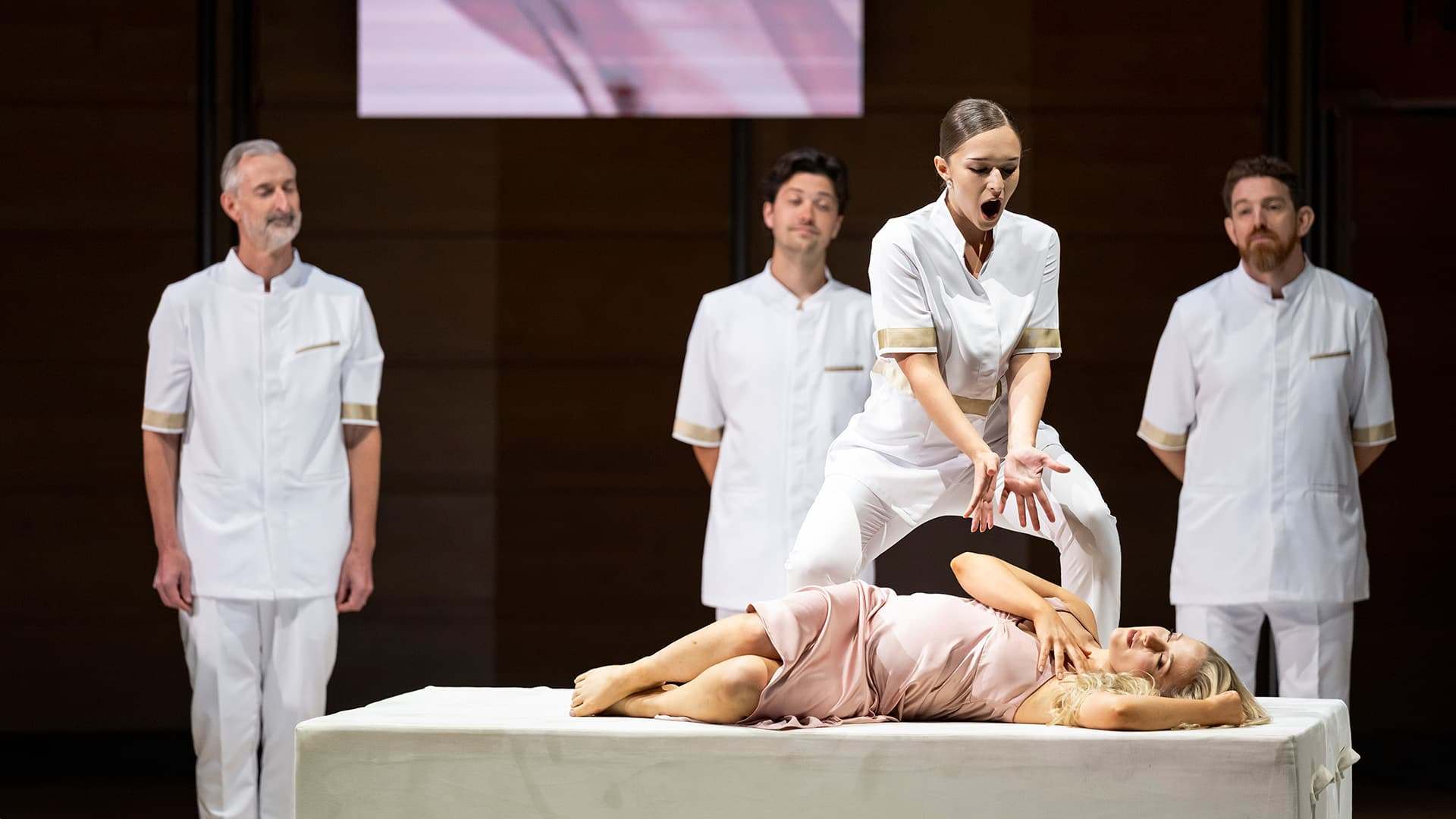
Secondly, he negotiated the hybrid nature of the work in many, tactful, ways. Though there was no scenery, and the orchestra was on stage, the surrounding audience boxes and staircases were integrated into the action as if they were already scenery. The chorus, full of soloists who performed the minor and not so minor characters, were on stage at the start and finish, but became an oratorio chorus in one of the boxes for most of the work, turning themselves, appropriately enough for the origin of the story in ancient Greece, into a Greek chorus. And when the arias presented absurdities with their da capos (as Gluck was to complain a few years later, they tend to stop the flow of the drama) he was not afraid to be really comic. For example, in Juno’s aria “Iris, hence away” Armfield gets over the Gilbertian “yes, but you don't go” moment by having Iris take off her smart stockings and put on her running shoes while Juno is exasperatedly urging her to get on with it.
A friend of mine thought there was too much kissing. Indeed there was plenty, as Semele quite literally cannot get enough of Jupiter. But, in a piece largely about a woman's lust, that seemed to me appropriate. And if Alexandra Oomens, dressed as she was in a shift which reminded me of Marion in Raiders of the Lost Ark, had leapt off the stage and applied those kisses to me, I would not have refused.
Some scenes provided just the opportunity for Armfield’s trademark perspicacity. Semele, already attractive enough to arouse the desire of a god, wants, like many young women, to be even more beautiful. When the jealous Juno plots Semele’s downfall, she gives her a magic beauty-enhancing mirror, resembling a mobile phone. The image was replicated on a screen with an airbrushed, photoshopped version of Oomens, in a nod to the possibilty that the gods have always known about AI.
Despite the challenges I have mentioned, and despite incongruities of genre, Armfield allowed the staging to articulate with the music so that the music became the holder of the emotional core of the action. I won't spoil the coup de théatre of the final scene, involving the birth of Bacchus from the union of Jupiter and Semele – just go and see the show.
I have a love/hate relationship with Handel. For someone who could write the most gorgeous tunes, tunes which Bach would have killed to write, his operas also often contain music which he must have realised wasn’t that great, and indeed was often by someone else. However, Messaiah is wonderful music from start to finish, and so is its immediate successor, Semele.
I sound like a cracked record when I say this, but the musical side of this production was a veritable feast for the ears. The orchestra included a baroque contra-bassoon, an instrument I had not seen before which purred with satin in the stygian lower reaches of the bass in the hands of Brock Imison. Matthew Greco led the band with even more than his usual panache, and Erin Helyard’s direction was, as ever, imbued with deep love and care, and a profound understanding of the score.
All of the singers embodied their characters in their singing. There’s a lovely quartet near the beginning that made me wish Handel had written more of them. Coloratura passages were well handled, especially by Oomens in her aria “O ecstasy of happiness”, where her speed and accuracy were breathtaking. David Webb, as Jupiter, was at his best when seductive or reflective, as in “Where ere you walk,” and “Ah, whither is she gone”, both sung with great lyrical tenderness. Indeed I could well imagine Webb’s Jupiter, disguised as a bull, allowing Europa to stroke his hide, in another of his divine seductions. Catherine Carby sang straight out of Juno’s jealousy, producing some remarkably threatening chest-voice notes. And the chorus (interestingly no longer called Cantillation, as in past Pinchgut productions, but simply the Ensemble) had such fun in their many and varied roles, yet were always sonorous and well-balanced.
After his blockbuster success with Messaiah, Handel may have thought he was close enough to immortality, like Semele, to achieve the impossible by creating opera in English. If so, he failed; Semele only lasted six performances, none of which were staged. But in the ashes of his failure he left us this astonishingly beautiful work.
Event details
Pinchgut Opera presents
Semele
by George Frideric Handel
Director Neil Armfield
Venue: City Recital Hall, Sydney NSW
Dates: 26 November – 2 December 2026
Bookings: www.pinchgutopera.com.au